
The workshop was co-chaired by Mr. Nguyen Manh Cuong, Alternate Member of the Central Committee of the Communist Party of Vietnam, Vice Chairman of the People's Committee of Ho Chi Minh City; Assoc. Prof. Dr. Tran Cao Vinh, Vice Director of VNUHCM; and Assoc. Prof. Dr. Hoang Cong Gia Khanh, Rector of the University of Economics and Law. Also attending the workshop were leaders from various departments and agencies of the city, and numerous experts and scientists from training institutions and research institutes both domestically and internationally.
Joining Hands to Create Development Momentum for Ho Chi Minh City
In his opening remarks at the workshop, Comrade Nguyen Manh Cuong emphasized that this is a strategic scientific event, co-chaired by the City government and the Vietnam National University Ho Chi Minh City (VNUHCM), demonstrating the spirit of "government - science - practice" working together to create a new development space for the City in the coming period.
He stated that the workshop is taking place in the context of the Politburo's approval of the principle for the City to comprehensively summarize Resolution No. 31-NQ/TW of the Politburo on the development of Ho Chi Minh City and to develop a new resolution to replace it, with a vision to 2075. This is an important basis for Ho Chi Minh City to propose the development of a Law on Special Urban Areas as a fundamental legal tool, creating conditions for strong decentralization and promoting growth.
According to the Vice Chairman of the Ho Chi Minh City People's Committee, despite its role as the economic engine with a large contribution to GDP and the national budget, Ho Chi Minh City is facing institutional bottlenecks as the current management model has not kept pace with the development requirements of a "megacity". In this context, the city is implementing a comprehensive process of summarizing practical experiences, developing new resolutions, and researching and proposing a Law on Special Cities in a coordinated and tightly integrated manner.
He emphasized that the law needs to fundamentally shift from a "special" mechanism to a "superior institution," from "proposals and recommendations" to "empowerment and accountability," while also aiming for a modern urban governance model. Based on this, the Law on Special Cities is oriented towards the following principles: ensuring genuine autonomy for urban authorities; removing practical bottlenecks; and expanding development space, including piloting new mechanisms.
Comrade Nguyen Manh Cuong also expressed his hope that experts and scientists would continue to contribute groundbreaking ideas, new approaches, and frank critiques, contributing to the completion of a highly feasible law that meets the development requirements of Ho Chi Minh City in the coming period.
Shaping the Policy for Special Urban Development
At the workshop, presentations and discussions focused on clarifying the position and role of Ho Chi Minh City in the national urban system, while proposing approaches to building the Law on Special Urban Development based on a combination of the city's development practices and international experience. Some notable presentations, such as "Positioning a New Development Position for Ho Chi Minh City – the Foundation for Building the Law on Special Urban Development" and "Proposing a Superior Structure, Policies, and Draft Law on Special Urban Development," provided important arguments for the completion of the draft law.
Many opinions emphasized the positioning of Ho Chi Minh City as the national economic and financial center and the country's growth pole, thereby requiring the design of superior governance mechanisms, increased decentralization and delegation of power, and enhanced autonomy of the urban government.
From a policy perspective, experts proposed building a legal structure that is open and flexible, focusing on key areas such as: specific financial mechanisms, a modern urban management system, urban spatial development, and promoting regional linkages. Some opinions also suggested approaching the Law on Special Cities as a long-term "development charter," creating a foundation for realizing a global urban vision.
In addition, international experience in institutional design for special cities was analyzed and compared, contributing to supplementing the scientific and practical basis for perfecting the draft law to suit Vietnam's conditions.
Laying the Foundation for a Special Urban Law for Ho Chi Minh City
In his concluding remarks at the workshop, Associate Professor Dr. Tran Cao Vinh stated that the workshop had recorded many insightful contributions, forming an important system of scientific and practical arguments for perfecting the draft law. There was a high degree of consensus on the need to innovate legislative thinking and implement substantive decentralization, emphasizing the shift from a "request-and-grant" mechanism to a post-audit mechanism, moving towards a central-level inspection and supervision mechanism to ensure the city's long-term proactive and stable role in planning, investment, and finance.
News & Events
/↳Ecosystem News
04/04/2026•VIH - VNUHCM Innovation Hub•4 min read
Comments on the Draft Law on Special Urban Areas: Proposing breakthrough policies for Ho Chi Minh City in the new era.
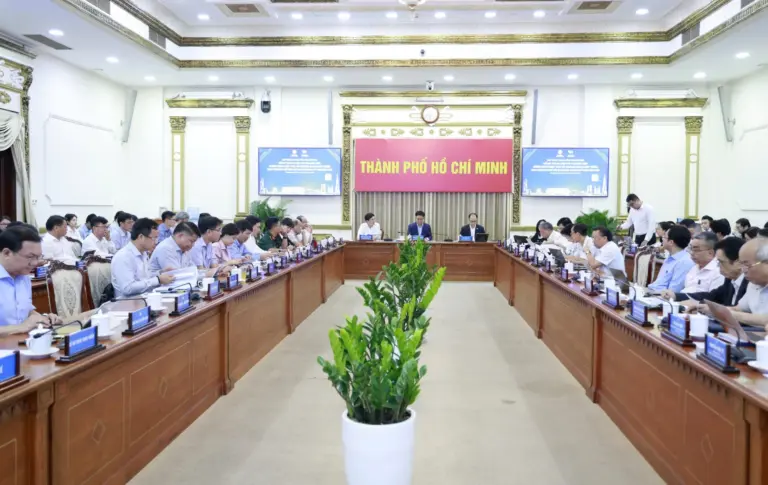
On the morning of April 4, 2026, the Vietnam National University Ho Chi Minh City (VNUHCM), in collaboration with the People's Committee of Ho Chi Minh City, organized a workshop to consult with experts on the draft Law on Special Urban Areas, themed "Breakthrough Policies and Development Space for Ho Chi Minh City in the New Era." The workshop is a concrete implementation of the cooperation program between the People's Committee of Ho Chi Minh City and VNUHCM for the period 2026-2030, aiming to mobilize the expertise of domestic and international experts and scientists to build a superior legal framework to support the completion of the draft Law on Special Urban Areas.
Image Gallery
Hashtags