
Welcoming and working with the VNUHCM delegation from Deakin University were Dr. David Halliwell, Pro Vice-Chancellor (Partnerships); Ms. Chaturika Bandara, Head of Strategy and International Partnerships; Dr. Huyen Bui, Manager of Education and Transnational Partnerships; Hayley Ho, Project Coordinator at Deakin International; and several Vietnamese-Australian scientists working at the university.
During the session, both parties engaged in deep discussions regarding cooperation in research, innovation, and postgraduate training. The VNUHCM delegation shared its ongoing strategic directions, including developing VNUHCM into a regionally influential hub for education, research, and innovation; promoting the "Triple Helix" model between Government, Academia, and Industry; and developing the VNUHCM Innovation Center as a focal point connecting strong research groups with practical challenges from localities and businesses.
A central focus of the working session was Deakin University's research commercialization model. Deakin introduced its researcher-led commercialization pathway, ranging from assessments of novelty, commercial viability, intellectual property, patents, and branding to licensing options for existing businesses or the formation of new ventures. Notably, Deakin’s model features a royalty-sharing mechanism where 33% of royalties are allocated to the creators, combined with support tools such as online modules, workshops, and expert mentoring to help scientists understand and participate more effectively in the commercialization process.
Deakin University also shared its experience in developing the Geelong Future Economy Precinct, an innovation space linked to manufacturing, applied research, and future industries. This model aims to bridge the gap between research and manufacturing through de-risked technologies ready for production with partners. Additionally, Deakin introduced REACH (Recycling and Clean Energy Commercialisation Hub), a prime example of the Triple Helix model where the university collaborates with industry, partner universities, and Australian Government support to guide research results across the "valley of death" on the journey to commercialization.
In the field of Information Technology and Artificial Intelligence, Associate Professor Thuong Hoang, Associate Head of School (Research) at the School of Information Technology, shared that the school's training activities are designed around professional competencies, innovation capacity, and work-integrated learning (WIL). Students participate in capstone projects, WIL modules, work with real clients, receive guidance from industry mentors, and present products to industry experts. This approach ensures that training remains aligned with the labor market and enables learners to develop practical problem-solving mindsets.
The session also highlighted notable experiences from programs such as the Future State Forum, where PhD students present research ideas in a "3 Minute Thesis" style to an industry panel; Industry Masterclasses to enhance corporate collaboration capacity for faculty; Industry PhD Cohorts linking doctoral training with industrial programs and problems; and the IT Advisory Board involving business leaders, alumni, and student representatives.
Another highlight was the presentation on Deakin University's Applied Artificial Intelligence Institute (A2I2), led by Professor Truyen Tran. A2I2 was introduced as a university-wide AI entity that connects AI research with application areas, supports the development of system-level solutions, and implements research into practice. This model demonstrates how a university can organize AI capabilities not just as a specialized research institute, but as a "shared capability layer" connecting various faculties, fields, and external partners.
Both sides also discussed the initiative to build Ho Chi Minh City into a regional education hub, attracting international students, retaining talent, and enhancing the international influence of Vietnamese higher education. VNUHCM shared its orientation to increase the scale of postgraduate training, promote international student enrollment, expand training cooperation with universities having similar educational systems, and strengthen faculty capacity through international collaboration.
Concluding the session, VNUHCM and Deakin University agreed to continue discussions to finalize cooperation in research, innovation, artificial intelligence, health sciences, postgraduate training, industry partnership, and research commercialization. The visit contributed to expanding VNUHCM’s international partner network while providing practical experiences to serve the development of the innovation ecosystem, Triple Helix cooperation, and the promotion of strategic technology sectors at VNUHCM in the coming time.
Partnerships & Ecosystem
/↳International Partnerships
06/05/2026•VIH - VNUHCM Innovation Hub•4 min read
VNUHCM and Deakin University: Promoting Cooperation in Innovation and Research Commercialization
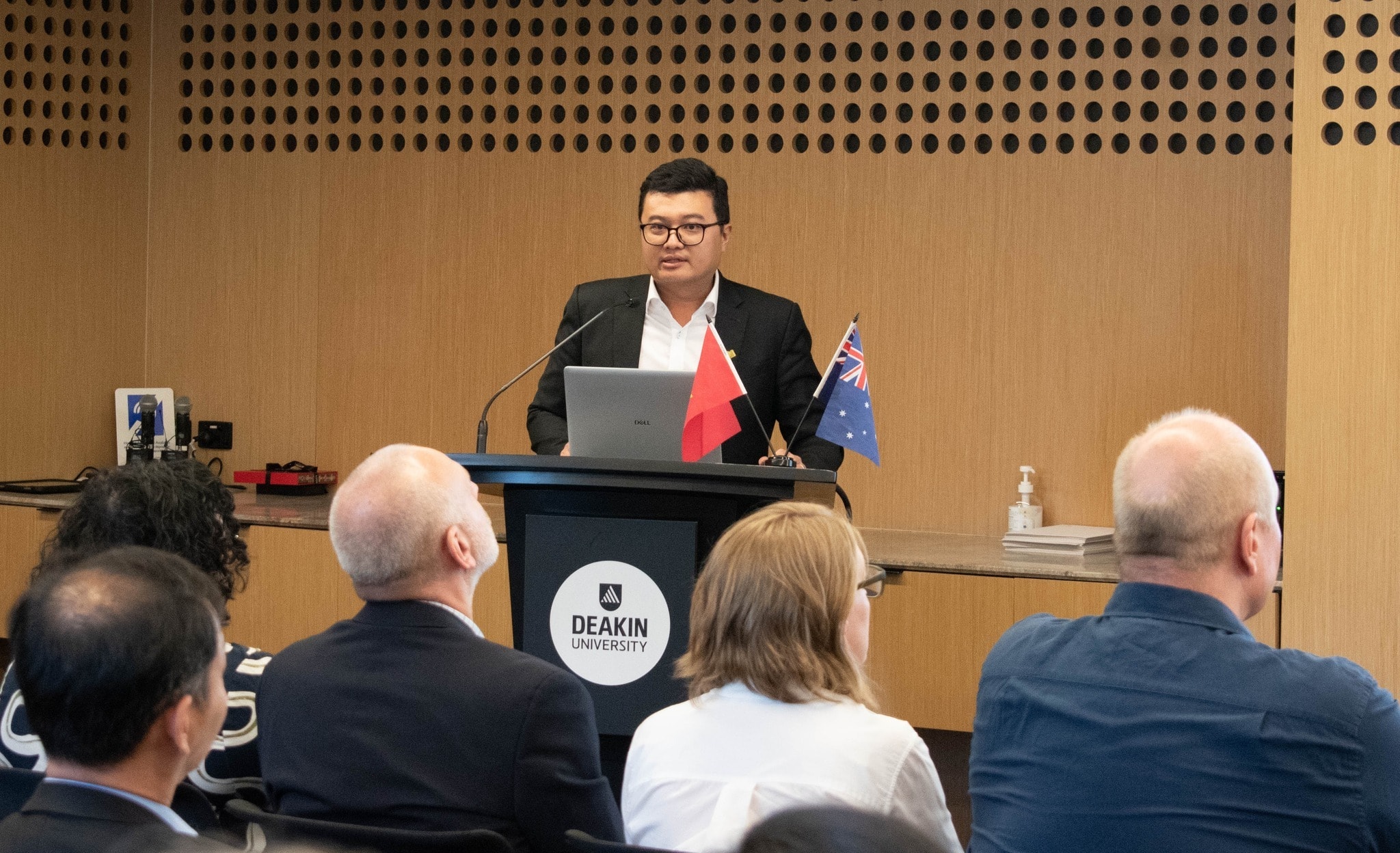
On the afternoon of May 1, 2026, as part of their official mission to Australia, the VNUHCM delegation, led by President Prof. Dr. Nguyen Thi Thanh Mai, held a working session with Deakin University. The meeting focused on exchanging models to promote innovation, research commercialization, and university-industry partnerships, while expanding joint training and research programs in priority sectors.
Image Gallery
Hashtags