
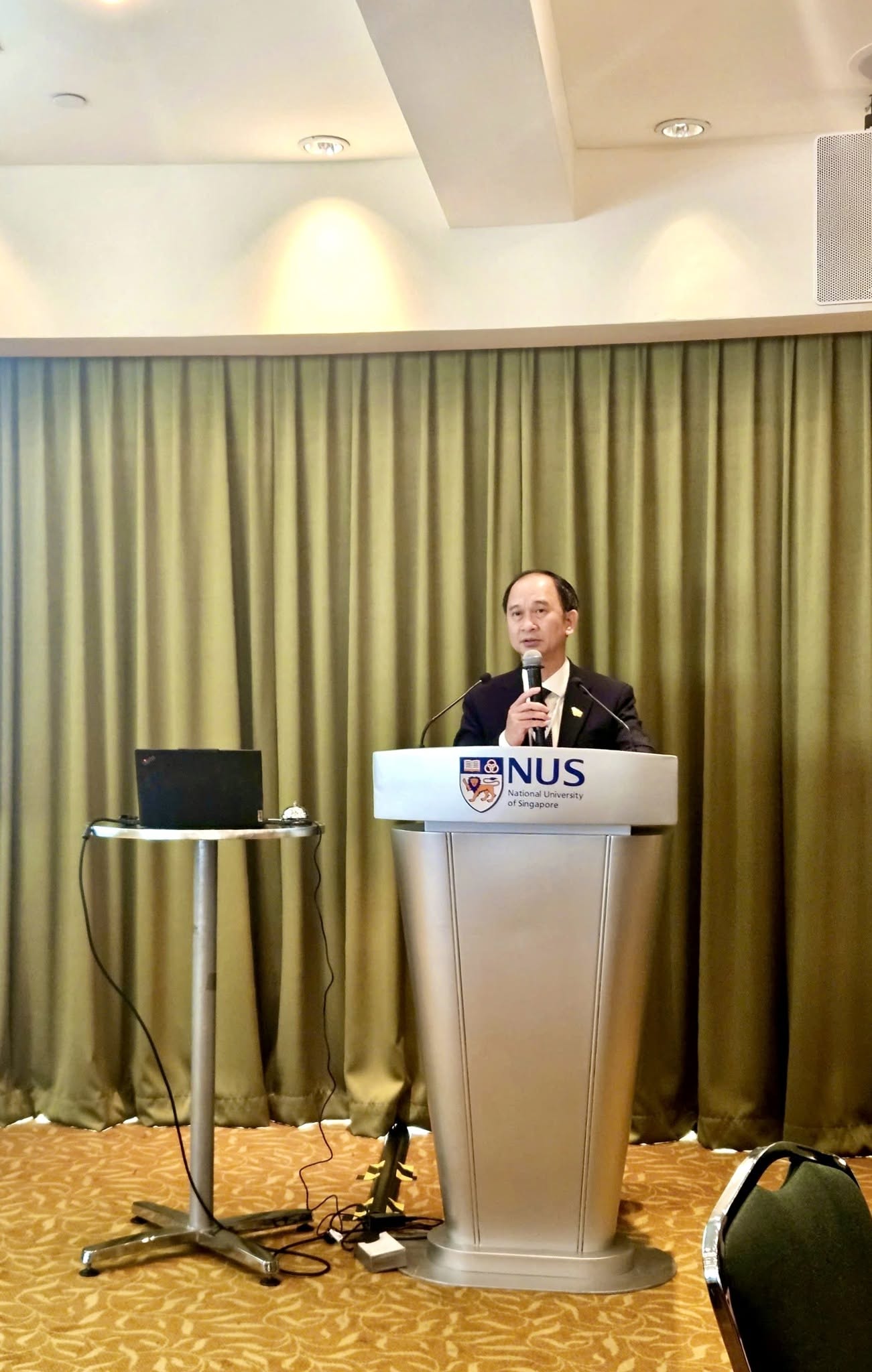
The first part of the programme focused on undergraduate education innovation, flexible curriculum design, and interdisciplinary education, with presentations by Professor Bernard Tan, Senior Vice Provost for Undergraduate Education; Associate Professor Martin Buist, Deputy Dean for Education, College of Design and Engineering (CDE); and Associate Professor Nicholas Hon, Vice Dean for External Relations and Student Life, Faculty of Arts and Social Sciences (FASS). The sessions aimed to explore how NUS develops its common curriculum, flexible learning pathways, interdisciplinary education between the social sciences, humanities, and natural sciences, as well as career readiness initiatives for students. The visit provided VNUHCM with valuable references for its ongoing efforts to innovate curricula and enhance the quality of higher education.
The practical experiences shared by NUS provided valuable insights for VNUHCM in general and VIH in particular in advancing higher education innovation, fostering interdisciplinary learning, and strengthening connections between academic training and the evolving needs of society.
The programme began with a session on Undergraduate Education, where Professor Bernard Tan shared NUS’s university-wide curriculum reform strategy. NUS aims to develop future-ready graduates through a Common Curriculum, Interdisciplinary Learning, flexible learning pathways, double majors, double degrees, major–minor structures, and programmes that integrate multiple fields of study. A key message from Professor Tan was that in higher education, experimenting with a new direction may lead to success or failure, but it is necessary in order to adapt to a rapidly changing world.
The delegation then joined a session with the College of Design and Engineering, presented by Associate Professor Martin Buist. CDE introduced its integrated education model that brings together design, engineering, and innovation, allowing students to “Build your own degree” by designing their own learning pathways through a combination of the common curriculum, their major, and open elective options. This model enables students to connect engineering expertise with artificial intelligence, data science, design, life sciences, economics, public health, and other social fields, thereby better responding to the needs of a diverse labour market.
At the session with the College of Humanities and Sciences (CHS), Associate Professor Nicholas Hon shared the model of interdisciplinary education between the Faculty of Arts and Social Sciences and the Faculty of Science (FoS). CHS is implemented with a common curriculum that includes courses in academic writing, data literacy, digital literacy, design thinking, social sciences, humanities, natural sciences, and interdisciplinary studies. In addition to its curriculum structure, CHS also introduced the Career Compass Series, a year-by-year career readiness roadmap that helps students gradually explore themselves, develop skills, participate in internships and international experiences, and prepare for entry into the labour market.
Through the discussions in the first part of the programme at NUS, CTLT - VIH gained valuable practical insights into higher education innovation, ranging from flexible curriculum design and interdisciplinary learning to the development of future-ready competencies for students. These experiences provide important references for CTLT - VIH as it continues to research, connect, and promote educational innovation initiatives, contributing to enhanced educational quality and the development of innovation-driven talent.
Original post: https://www.facebook.com/share/p/1Nv27QWAAt/