
During the working session, representatives from the University of Melbourne provided an overview of the institution's history, educational model, and research directions. Founded in 1853, the University of Melbourne is one of Australia’s oldest and most prestigious universities, currently hosting approximately 57,000 students, with international students from over 150 countries accounting for nearly half of the population. A standout feature of the university is its balanced structure between undergraduate and postgraduate education, along with the "3+2" model, where students complete broad-based bachelor's programs before pursuing specialized postgraduate training.
The University of Melbourne representatives also shared insights into their flexible curriculum, which encourages interdisciplinary learning by allocating a significant portion of credits to elective modules outside a student's major. This approach helps learners develop a broad mindset, adaptability, and the ability to connect knowledge in the context of a rapidly changing labor market and scientific-technological landscape.
On behalf of VNUHCM, Prof. Dr. Nguyen Thi Thanh Mai introduced the strategic directions for VNUHCM's new development phase, particularly its strengths in Science, Technology, Engineering, and Mathematics (STEM); its focus on enhancing postgraduate education quality; promoting interdisciplinary research; and connecting students and researchers with strong research groups and highly applicable research programs. VNUHCM also emphasized its policy to accelerate internationalization and expand cooperation with world-leading universities, especially in student exchange, joint PhD supervision, the development of high-quality training programs, and the implementation of joint research projects.
Both parties acknowledged the existing collaborative foundations between the University of Melbourne and several VNUHCM member units, including academic exchanges with the University of Science in biotechnology and sustainable biology, as well as connections with the University of Economics and Law in economics, business, and management. These were viewed as favorable foundations for the two universities to expand system-level cooperation in the near future.
A central point of discussion was the possibility of establishing a university-level Memorandum of Understanding (MoU) between the University of Melbourne and VNUHCM. Based on this framework, both sides could continue to develop specific collaborations at the levels of member schools, faculties, institutes, and research groups. Proposed areas of cooperation include student exchanges, the development of short-term and long-term academic programs, joint PhD supervision, connecting research groups in areas of mutual interest, and designing research programs integrated with postgraduate training.
VNUHCM also highlighted the current favorable domestic conditions for developing science, technology, and innovation, including strong investment from the Government, the Ministry of Science and Technology, and Ho Chi Minh City for research programs, high-quality human resource training, and the development of the innovation ecosystem. This serves as a vital platform for VNUHCM to promote in-depth international cooperation that links research with training, knowledge transfer, and solving developmental challenges for localities, businesses, and society.
Professor Eduard Hovy, Executive Director of Melbourne Connect, followed up on the delegation's previous tour by further introducing Melbourne Connect’s activities. He suggested that when referencing experiences for Vietnam, the key is not to replicate an existing model but to start with the major challenges of the locality and nation—such as agriculture, transportation, infrastructure, healthcare, public administration, and digital transformation. From there, universities can form interdisciplinary groups comprising students, faculty, scientists, businesses, and international experts to co-develop solutions within a targeted cycle of experimentation and specific outcome evaluation.
The session concluded with an agreement to continue discussions following the mission to finalize cooperation opportunities. Both sides expressed high expectations that developing the partnership between the University of Melbourne and VNUHCM will open new pathways in academic exchange, postgraduate training, joint research, and innovation, contributing to strengthening the connections between the university-business-government ecosystems of Vietnam and Australia.
Partnerships & Ecosystem
/↳International Partnerships
05/05/2026•VIH - VNUHCM Innovation Hub•3 min read
VNUHCM Strengthens Strategic Partnership with the University of Melbourne in Training, Research, and Innovation
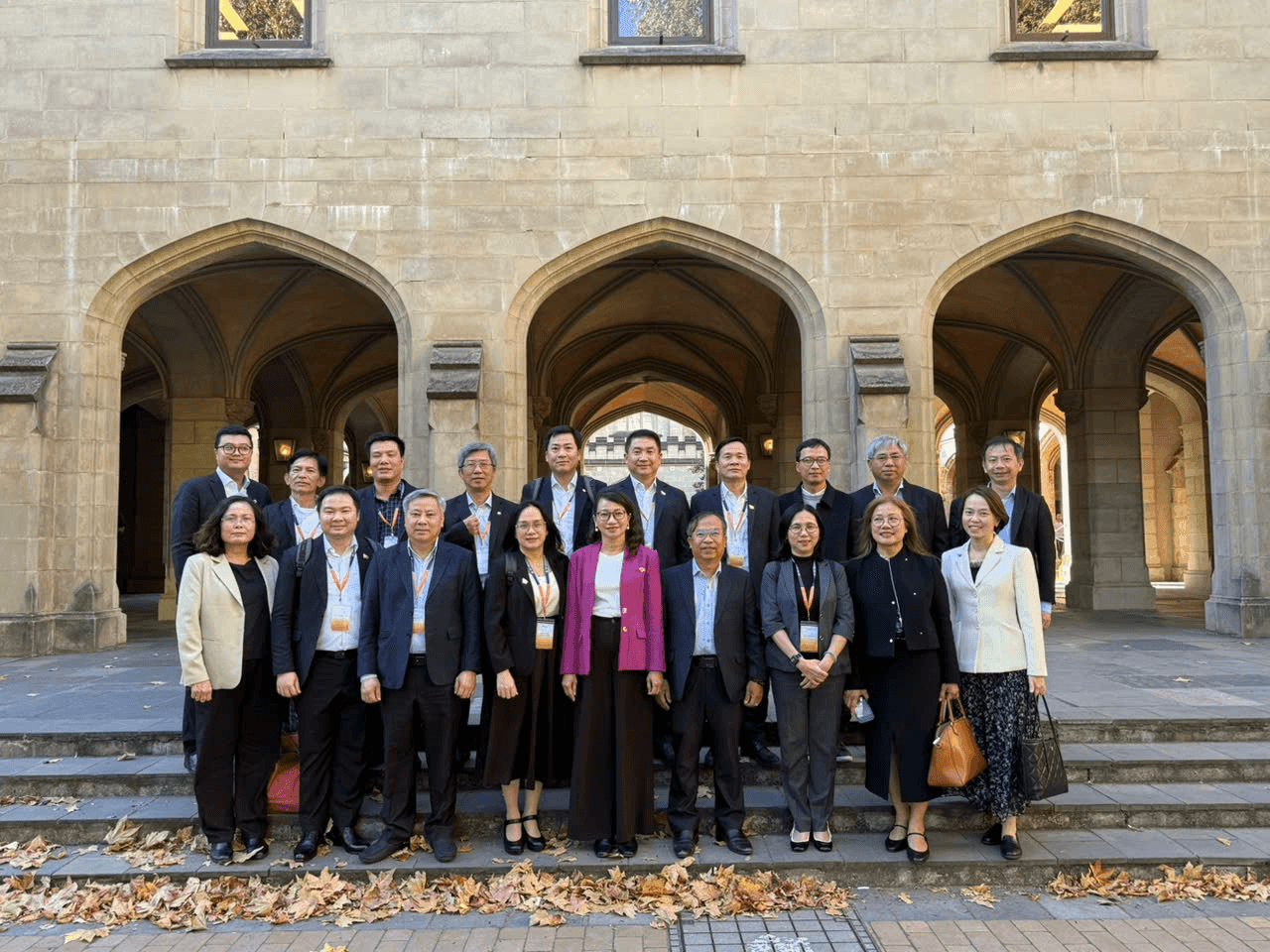
On the afternoon of May 1, 2026, as part of their official mission to Australia, the VNUHCM delegation, led by President Prof. Dr. Nguyen Thi Thanh Mai, held a working session with the University of Melbourne. The delegation was received by Professor Michael Wesley, Deputy Vice-Chancellor (Global, Culture and Engagement) of the University of Melbourne, along with leaders from various faculties and departments currently engaged in or seeking cooperation with VNUHCM member universities.
Image Gallery
Hashtags