
Here is the translation of the detailed text into professional English, maintaining a formal and academic tone suitable for an official report or news release.
VNUHCM and Swinburne University of Technology: Building an End-to-End Innovation Ecosystem
During the working session, representatives from Swinburne University of Technology provided an overview of the university’s platform for commercialization and innovative enterprise development. The discussion focused on how Swinburne has built an on-campus innovation ecosystem that connects faculty, researchers, students, businesses, startups, investors, and other ecosystem partners.
A standout feature of Swinburne’s model is that innovation is not merely a side activity but a strategic component designed to create value for partners while sharing that value back with the university. Swinburne’s vision is to act as a catalyst for co-creating value with partners through three objectives:
Fostering a culture of innovation and entrepreneurship campus-wide.
Contributing to the university’s financial sustainability through corporate partnerships, innovation education, commercialization, and innovation services.
Creating pathways to translate university research and capabilities into large-scale commercial impact.
Swinburne highlighted five priority pillars for operating its ecosystem:
Establishing research commercialization mechanisms.
Developing sustainable external revenue from integrated products and assets.
Enhancing commercial capabilities for staff, students, and professional teams.
Promoting student entrepreneurship (including internships and placements at startups and industry partners).
Building appropriate incentive systems and mechanisms.
These foundational elements ensure that innovation becomes a strategic choice rather than a short-term trend.
The "Full-Stack Innovation Ecosystem" Model
The VNUHCM delegation took particular interest in Swinburne’s “full-stack innovation ecosystem,” which consists of four main components:
Talent Development: Programs such as majors, minors, PhDs, industry-sponsored PhDs, graduate certificates, micro-credentials, internships, placements, masterclasses, and the Venture Cup.
Research Collaboration: Collaborative research projects, researcher exchanges, contract research, consulting, and networking conferences.
Innovation Services: Challenge-based innovation, innovation audits, IP management, legal/financial services, and translational facilities like the Factory of the Future, Digital Innovation Lab, and Protolab.
Commercial Development: IP licensing, IP spinouts, venture builders, commercial co-founder programs, pre-seed co-investment, Swinburne Ventures Limited, investment networks, and the industry-on-campus co-location model.
This approach demonstrates that university innovation must be designed as a complete value chain: from education and ideation to research connectivity, IP protection, product development, market validation, fundraising, commercialization, and scaling. This aligns with VNUHCM's direction to leverage its strengths in STEM, basic sciences, and strategic technologies through Triple Helix collaboration (Government-University-Industry) to create practical value for Ho Chi Minh City and the Southeast region.
Innovation Studio and the Power of Connection
Another highlight is the Swinburne Innovation Studio, which connects founders, researchers, and students with industry partners to support high-potential ventures. Rather than just providing space, the Studio operates structured, founder-led support programs that integrate mentoring, coaching, and access to Swinburne’s research capacity, talent, capital, and infrastructure.
The Studio’s programs are tailored to different venture stages: Initiate (ideation), Luminate (validation), and Elevate (growth). The Venture Cup, an annual flagship pitching event, allows teams from the Elevate program to showcase their progress to investors.
Investment and Success Stories
Swinburne also introduced Swinburne Ventures Limited, an investment platform supporting high-potential enterprises. Key highlights include:
An AUD 18 million partnership fund with Breakthrough Victoria.
Investments ranging from AUD 100,000 to 1 million across Proof of Concept, Pre-seed, and Series A stages.
A portfolio of over 20 investments, focusing on ventures originating from students, faculty, alumni, and research across all sectors.
A prime example is Fluency, an AI startup co-founded by a Swinburne engineering student. Fluency uses AI to automate process documentation across various apps. After participating in the Luminate and Elevate programs and winning "Best Pitch" at the Venture Cup, the team successfully raised pre-seed funding in April 2025 from Archangel Ventures and other investors.
Future Cooperation and VNUHCM’s Vision
The VNUHCM delegation highly valued Swinburne’s structured, well-resourced system and clear commercialization mechanisms. These experiences offer practical reference points for VNUHCM as it develops the VNUHCM Innovation Center, centers of excellence, strong research groups, and industry-aligned training programs.
Given its large scale, STEM strengths, and extensive network of member universities, research institutes, and alumni, VNUHCM is well-positioned to develop its own unique innovation ecosystem. Potential collaboration areas with Swinburne include:
Adopting the Innovation Studio model.
Developing "Train the Trainer" programs for innovation and entrepreneurship.
Organizing joint masterclasses and connecting research/startup groups.
Consulting on research commercialization, IP governance, and spin-off formation.
Developing challenge-led innovation programs in AI, digital manufacturing, energy transition, climate tech, and strategic technologies.
The working session opens deep collaborative opportunities, particularly as VNUHCM promotes its Triple Helix model to transform university knowledge into impactful products, solutions, and tech enterprises. Swinburne's experience proves that an innovative university is not just a place where knowledge is created, but where it is organized into capability, enterprise, and social value.
Partnerships & Ecosystem
/↳International Partnerships
03/05/2026•VIH - VNUHCM Innovation Hub•4 min read
VNUHCM collaborates with Swinburne University: From an end-to-end innovation ecosystem to research commercialization and tech enterprise development
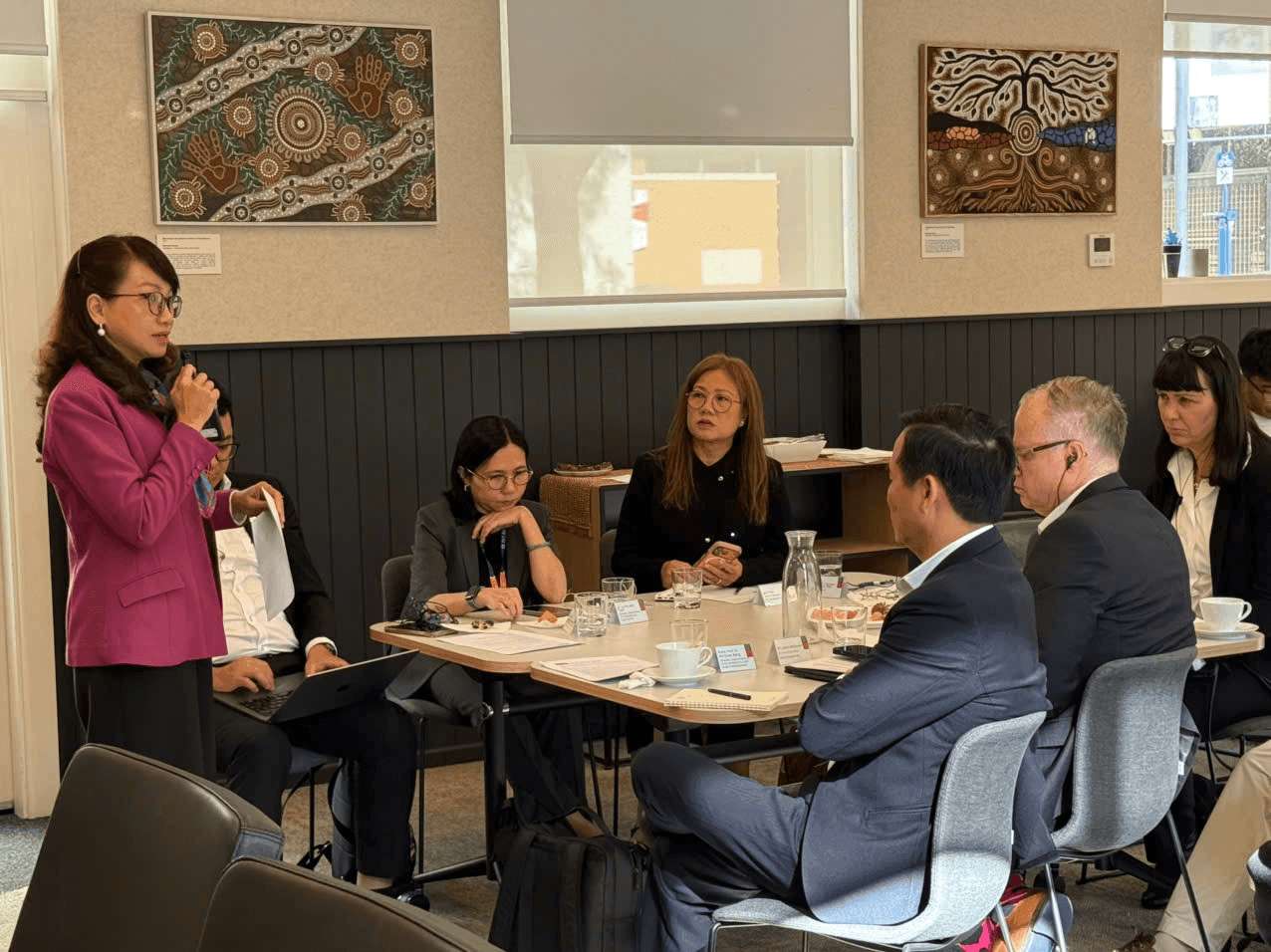
On the morning of May 1, 2026, during an official visit to Melbourne, Australia, a delegation from Vietnam National University Ho Chi Minh City (VNUHCM), led by its President, Prof. Dr. Nguyen Thi Thanh Mai, held a working session with Swinburne University of Technology. The meeting focused on exchanging experiences in developing university-based innovation ecosystems, promoting the commercialization of research findings, fostering tech-enterprise growth, and innovating academic programs to align with practical demands.
Image Gallery
Hashtags