
During the working session, both parties discussed orientations for expanding cooperation in training, scientific research, technology transfer, and innovation. UNSW introduced its strategic priorities for its new development phase, emphasizing the spirit of “Progress for All” and positioning itself as a university with strong capabilities in entrepreneurship, spin-offs, and international connectivity. The university aims to cultivate an entrepreneurial spirit within the academic community, with over 10,000 students experiencing startup activities annually, and aims to be ranked No. 1 in Australia by 2031 for the number of startups and spinouts formed from technology developed on campus.
A notable highlight was the UNSW Founders Program and the Global Innovation Foundry models. These are platforms that support students, faculty, scientists, and alumni in building entrepreneurial capacity, developing tech companies, and expanding into international markets. The Global Innovation Foundry was introduced by UNSW with the goal of supporting 100 startups in scaling globally through connections with investors, government partners, market experts, and international networks.
Following the session, the delegation visited the UNSW RNA Institute, where Prof. Pall Thordarson, Director of the UNSW RNA Institute, introduced the organizational model, research capacity, and the RNA ecosystem in New South Wales. Established in 2021 with investment from UNSW and NSW Health OHMR, the UNSW RNA Institute aims to develop the RNA ecosystem of New South Wales and Australia while advancing RNA technology from discovery and preclinical research to clinical translation.
The delegation was introduced to the GMP RNA facility, which recently opened on April 21, 2026, with a total investment of $96 million. It is capable of producing over 1 million doses of mRNA vaccines and mRNA products for clinical trials. Notably, the facility expressed a desire to cooperate with partners in the Asia-Pacific region, including Vietnam.
The UNSW RNA Institute represents a distinctive interdisciplinary organizational model, connecting strengths in science, engineering, biomedicine, and medicine. The institute currently hosts 32 academic research groups across Science, Engineering, and Medicine & Health, focusing on priority areas such as infectious diseases, cancer, rare and genetic diseases, and neurological disorders. In addition to its research arm, the Institute has a manufacturing arm with ISO 9001-certified facilities capable of producing synthetic RNA, plasmid DNA, mRNA, and lipid nanoparticle formulations for preclinical research.
Next, the delegation visited the Automated Organic Synthesis Laboratory, introduced by Prof. Nguyen Thanh Vinh. Here, the delegation learned more about the traditions, research capabilities, and development directions of the UNSW School of Chemistry. Established in 1879, the School of Chemistry is currently ranked 38th in the world and 1st in Oceania according to the QS Chemistry Rankings; its research directions include medicinal chemistry, catalysis and energy, space-atmosphere-origins of life, environmental chemistry, and materials.
To conclude the program, the delegation visited the Michael Crouch Innovation Centre (MCIC), an innovation space at UNSW under UNSW Founders. MCIC was introduced as a center that supports students, innovators, and startup teams in developing entrepreneurial skills, testing ideas, prototyping, and connecting with the startup support ecosystem.
The visit to UNSW has opened up many practical cooperation suggestions for VNUHCM in the fields of biotechnology, RNA/mRNA, applied chemistry, life sciences, technology transfer, innovative entrepreneurship, and the development of university-based innovation center models. This also serves as an important foundation for VNUHCM to further concretize its strategy of developing basic sciences integrated with strategic technologies, promoting "Triple Helix" cooperation, and expanding its international partner network in the coming period.
Partnerships & Ecosystem
/↳International Partnerships
06/05/2026•VIH - VNUHCM Innovation Hub•3 min read
VNUHCM and UNSW Sydney: Collaborating on RNA Research and Developing the Innovative Entrepreneurship Ecosystem
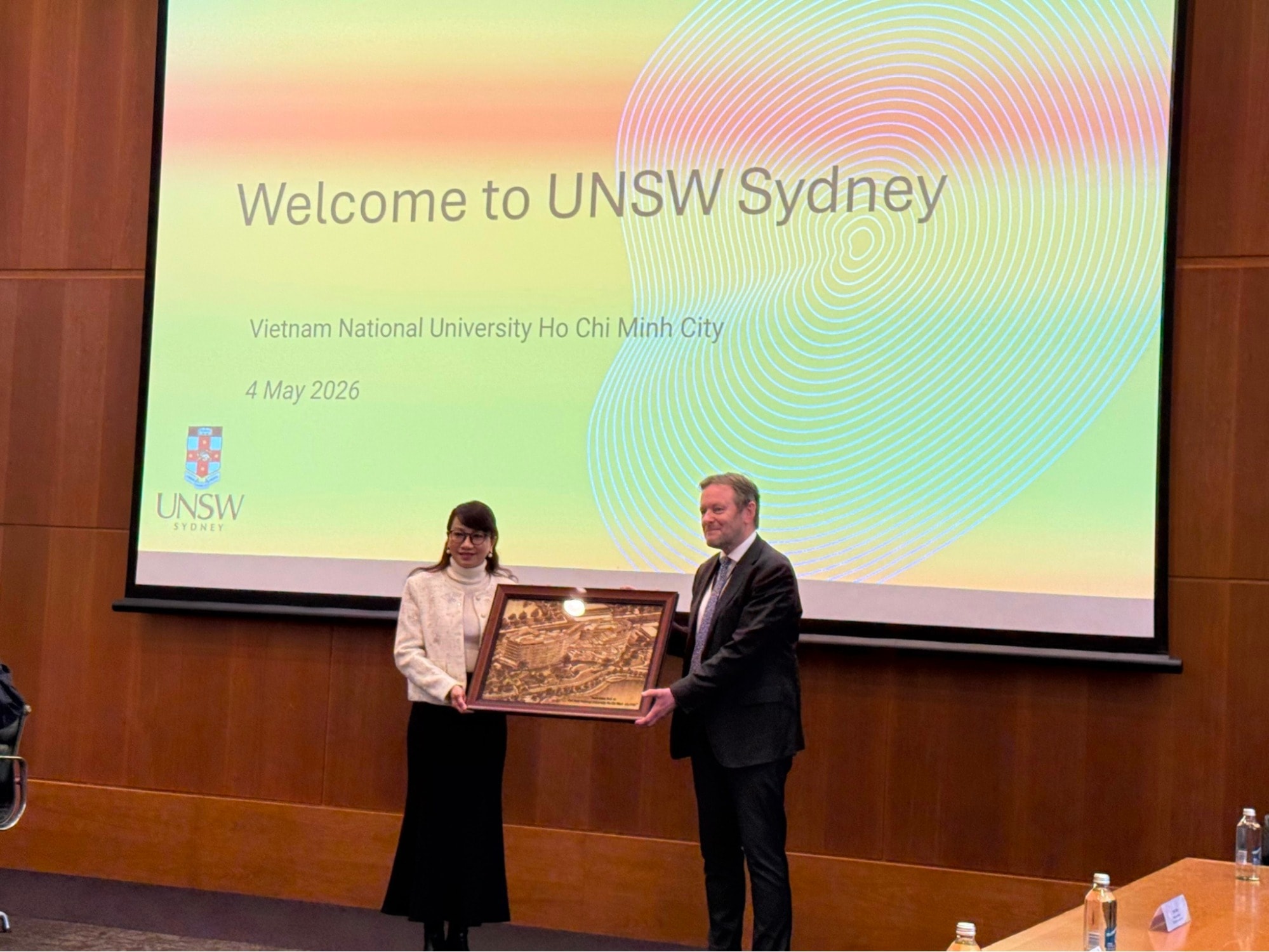
As part of their official mission to Australia, the VNUHCM delegation, led by President Prof. Dr. Nguyen Thi Thanh Mai, visited and held a working session with representatives from the University of New South Wales (UNSW Sydney). During the visit, the delegation also toured the UNSW RNA Institute, the Organic Chemistry Laboratory, and the Michael Crouch Innovation Centre.
Image Gallery
Hashtags