
Welcoming and working with the delegation were Mr. Innes Ireland, Acting Deputy Vice-Chancellor (Global Partnerships); Professor Peta Wyeth, Dean of the Faculty of Engineering and Information Technology; Professor Eryk Dutkiewicz, Associate Dean (International) of the Faculty of Engineering and Information Technology; Professor Long Nghiem, Director of the School of Civil and Environmental Engineering; Associate Professor Diep Nguyen, Director of Transnational Education; Associate Professor Quang Ha, School of Electrical and Data Engineering, along with representatives from various specialized units of UTS.
During the session, both parties discussed the results of their past cooperation, particularly the partnership between UTS and the University of Technology, VNUHCM. This model was evaluated as a typical success, creating an important foundation to expand the relationship from the unit level to a system-wide cooperation between UTS and VNUHCM.
A highlight of the UTS - University of Technology model is the ability to effectively solve the problem of academic compatibility—one of the largest barriers in international educational cooperation. On this basis, dual-degree programs and joint PhD supervision models in the fields of information technology and artificial intelligence have been effectively implemented. Maintaining annual academic workshops in Vietnam has also contributed to forming a cohesive community of experts between the two sides, creating a premise for transitioning from academic research to high-value practical applications.
Speaking at the session, Prof. Dr. Nguyen Thị Thanh Mai thanked UTS for the warm reception and emphasized that VNUHCM wishes to develop cooperation with UTS in a substantive, long-term direction capable of creating impacts in high-quality human resource training, interdisciplinary research, technology transfer, and innovation. The President of VNUHCM stated that the existing collaborative results between UTS and the University of Technology serve as an important anchor for the two sides to expand into strategic areas aligned with Vietnam's development needs and UTS's strengths.
In the new phase, both sides discussed four core areas of cooperation:
**First, the semiconductor industry**, specifically integrated circuit (IC) design training and workforce development. VNUHCM identifies this as a strategic field, aligned with Vietnam's priority in developing core and strategic technologies.
**Second, clean energy and green transition**, with research directions focused on energy storage batteries, hydrogen, and technological solutions for sustainable development. This area can leverage UTS's strengths in applied research while meeting Vietnam's urgent needs in the energy transition process.
**Third, telecommunications and aerospace technology**, including 5G/6G, autonomous control, unmanned aerial vehicles (UAVs), and related technological platforms. Both sides also discussed the possibility of utilizing UTS's research infrastructure, such as TechLab, in combination with new laboratories at VNUHCM to promote joint research and technology transfer.
**Fourth, applied artificial intelligence for social impact.** Building on projects already implemented in water monitoring in Phu Yen and the Mekong Delta, both sides agreed to continue seeking opportunities to apply AI in healthcare, the environment, and local development issues. This cooperative direction reflects an approach to turning high technology into cost-effective, high-impact solutions capable of serving the community.
Regarding implementation mechanisms, the two sides discussed expanding postgraduate training programs, including PhD programs with flexible timelines, joint supervision models between UTS and VNUHCM professors, and connecting corresponding research groups based on priority topics. Both sides proposed establishing focus groups to strengthen academic connectivity and organizing hybrid workshops, thereby enabling scientists from both sides to identify highly feasible joint research topics.
Beyond STEM fields, UTS and VNUHCM also explored the possibility of expanding cooperation into law, business, and management, moving toward a more comprehensive, multidisciplinary partnership model in the future.
Both sides also frankly discussed several challenges in the cooperation process, such as identifying the right experts with shared research interests between two large systems, as well as legal procedures in international joint training. To address these, they proposed increasing periodic specialized meetings between academic groups and forming focal working groups to quickly handle related technical and administrative procedures.
The session affirmed the potential for developing a strategic partnership between VNUHCM and UTS based on mutual benefit, value creation, and social impact. In the coming time, the two sides will continue to organize in-depth meetings between research groups, selecting pilot areas such as semiconductors, AI, and clean energy to build specific cooperation programs, while also promoting study tours of UTS's TechLab operational model to serve the development of research and innovation infrastructure at VNUHCM.
The visit and working session at UTS were significant activities in the VNUHCM delegation's mission to Australia, contributing to the concretization of internationalization goals, promoting cooperation with world-prestigious universities, and enhancing VNUHCM's role in the science, technology, and innovation ecosystem of Vietnam and the region.
Partnerships & Ecosystem
/↳International Partnerships
07/05/2026•VIH - VNUHCM Innovation Hub•4 min read
VNUHCM & UTS: Elevating System-level Cooperation in Training Key Technology Sectors
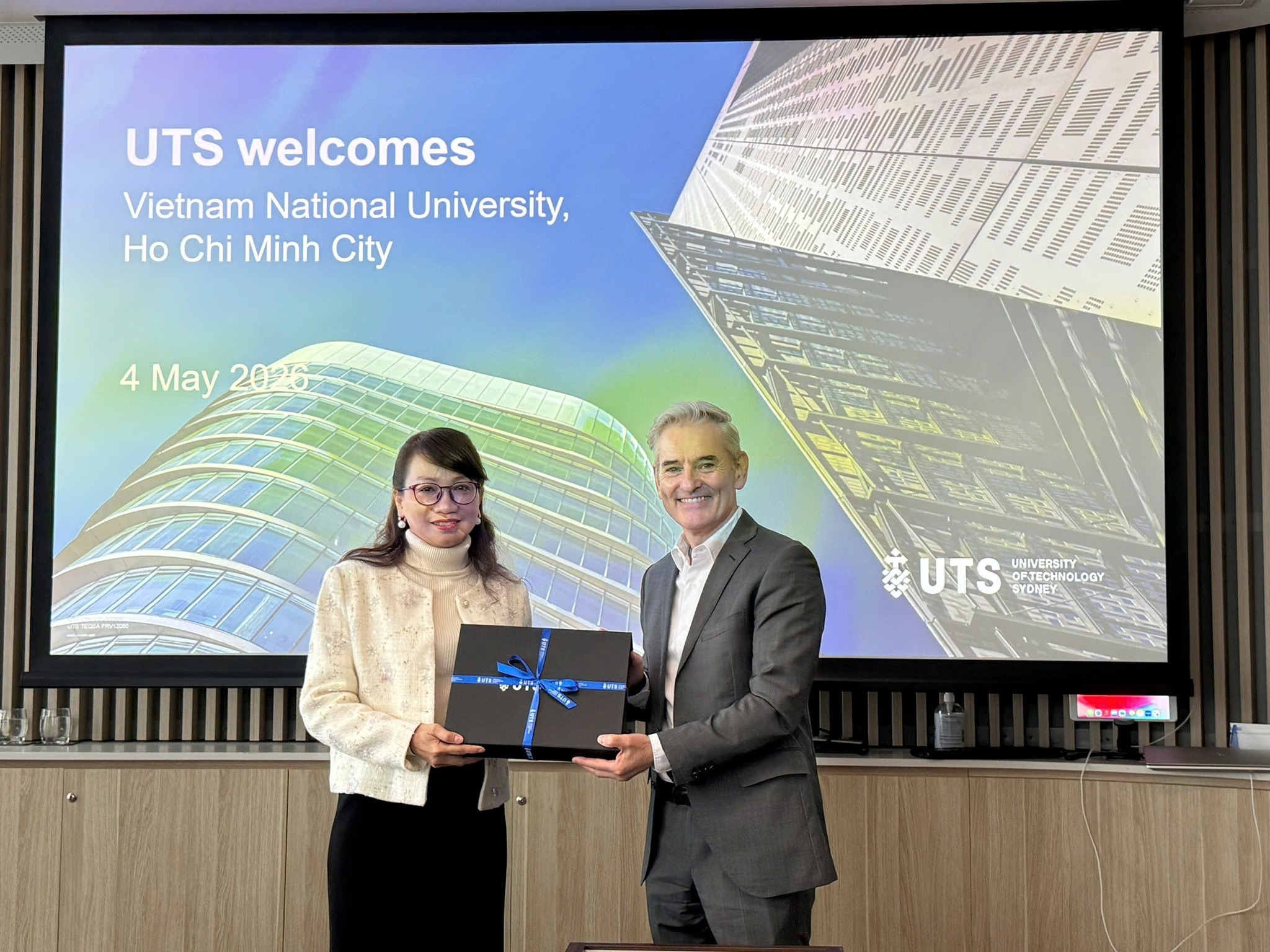
On May 5, 2026, as part of their official mission to Australia, the VNUHCM delegation, led by President Prof. Dr. Nguyen Thi Thanh Mai, visited and held a working session with the University of Technology Sydney (UTS).
Image Gallery
Hashtags